

Partnership formed to restore Gilbert Building to original appearance

Christmas tree placed in first-floor lobby of building
By Dannie Oliveaux | dannieoliveaux@theexaminer.com
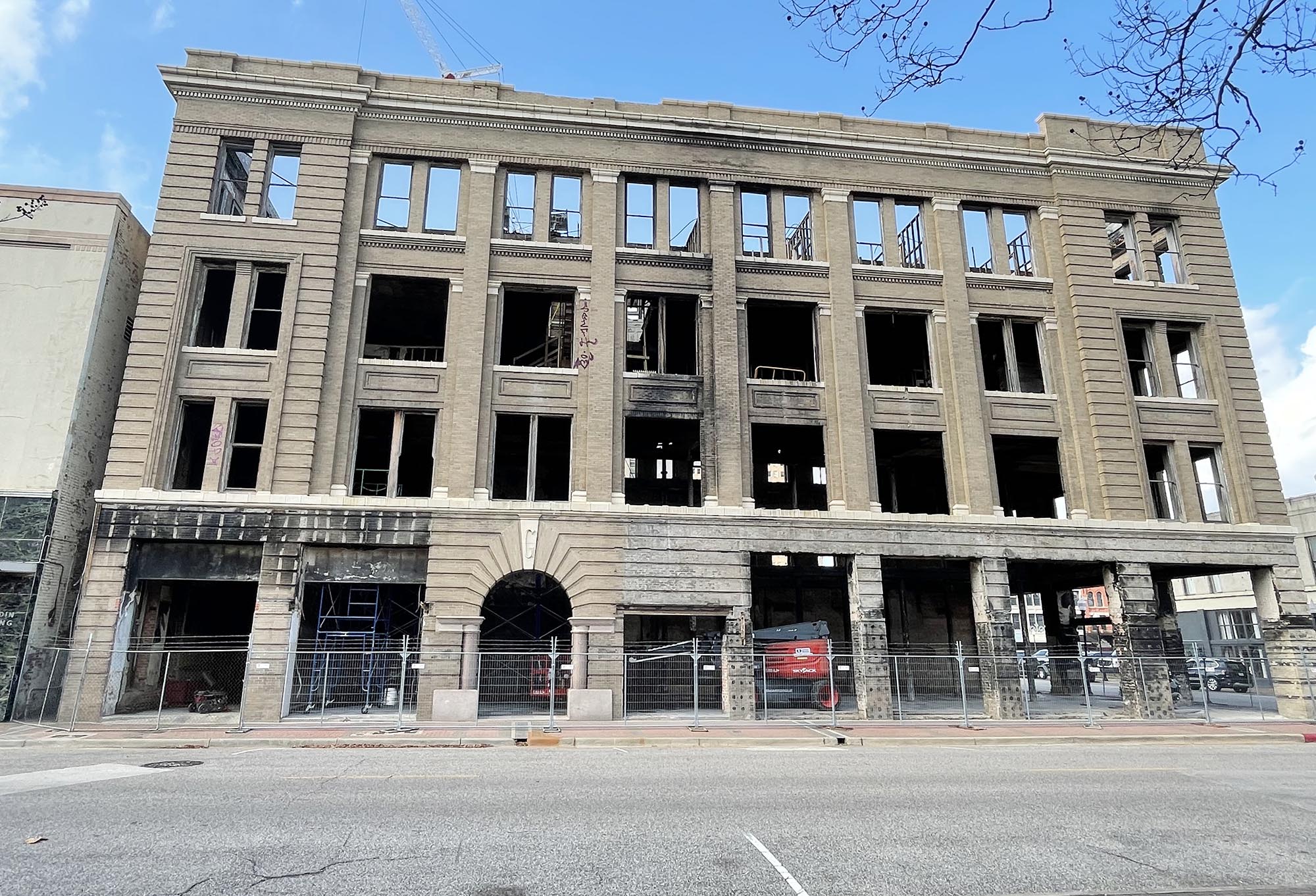
The night of June 6, 2024, a fire ripped through the historic Gilbert Building, 338 Bowie St. in downtown Beaumont, leaving only the walls and roof standing.
Months later, the Beaumont City Council voted 6-1 to approve an ordinance declaring the fire-damaged Gilbert Building an imminent danger on March 18, 2025. The ordinance ordered owner Tom Flanagan to demolish the structure within five days. The action followed a public hearing and a presentation by the property owner outlining progress toward bringing the building up to code.
Now under new leadership, the building has a “new lease on life.”
Aug. 8, 2025, Chris Richardson, owner of Lone Star Rigging, and Rob Fuselier, owner of Alliance Engineers & Project Consultants, formed a partnership to purchase the 123-year-old building, which was built by John Gilbert, from Flanagan. In September, the council approved the maximum allowable 100% tax abatement for the new owners.
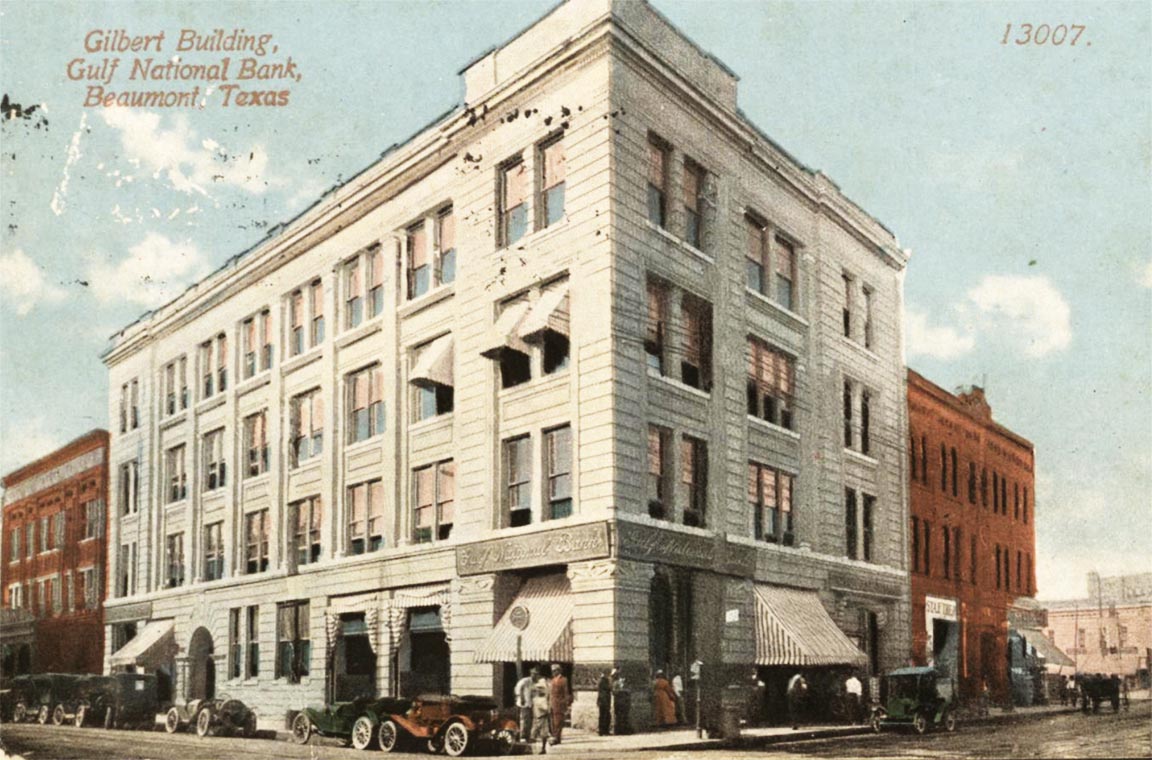
Since then, work has been underway at the Gilbert Building as the new owners aim to restore the historic establishment to its original 1902 appearance. Richardson said the focus has been on completing demolition and removing materials damaged by the fire.
“Since Rob and I took it over in August, the past three or four months have been predominantly about finishing the demolition and cleanup,” Richardson said. “We’ve been securing everything that was unsecured so there are no dangerous conditions overhead. A lot of it has been planning. I call it the planning and demolition phase.”
Richardson said the building contains about 7,200 square feet per floor, with plans for common areas, restrooms, a conference room and administrative offices adjacent to main offices on the second, third and fourth floors. He said office space will be divided by floor, with individual tenants determining how their space is configured.
“Some of that is going to depend on what the Historic Commission says,” Richardson said. “We’re probably talking about 10 offices per floor.”
Plans for the ground floor are still being developed.
“There are plans for a retail venue that we’re working on, but I’m not at a point to say what it’s going to be yet,” he said.
Richardson noted an area adjacent to the first floor could potentially be used as a smaller office space, if needed.
As for the project’s overall cost, Richardson said it will depend on what the Historic Commission allows during the build-out process.
“How the individual tenants build out their space will also be based on their taste,” he said. “Do they want plush walls, or do they want plaster and sheetrock? It just depends.”
Restoring the building to its early-1900s appearance presents challenges, Richardson said.
“The exterior is not hard to do,” he said. “It’s the interior where it gets complicated. But it still has to be functional.”
Richardson said the restoration must adhere to historically significant elements from the building’s construction through approximately the 1930s.
The second and third floors were almost completely demolished by the fire, he said.
“There’s a little bit on the third floor we’re going to be able to preserve, including some of the flooring,” Richardson said. “The second floor was pretty much wiped out.”
He said the owners were fortunate that the fourth floor sustained minimal damage, aside from an area about 20 feet by 15 feet.
“The roof you see now is gone,” Richardson said. “That was actually created from a secondary fire. Flames went up and came back down on the old asphalt roof, which then burned. The fire burned from the ground up to the third floor, but not through the fourth floor. The damage there came from the fire coming down from the roof.”
Richardson said much of the fourth floor will be preserved. When the building was originally constructed, the fourth floor was a large open space.
“Organizations like the Elks and Masons, along with others, used the area,” he said. “It was a really big open layout when it was first built.”
The space was later divided into offices.
One early concern, Richardson said, was whether the building could be occupied.
“At this point, we have firm commitments for three of the floors,” he said.
In December, the owners placed a lighted Christmas tree in the empty first-floor lobby.
“We just wanted to be in the Christmas spirit,” Richardson said. “We’re bringing it back to life. We also had the crane lit up with Christmas lights at night.”
During one Saturday in December 2025, crews removed the 110-year-old elevator drawworks, which were installed in 1915.
“It’s a mechanical wonder,” Richardson said.
When the building was constructedin 1902, it did not have an elevator. After a roof fire on Christmas in 1914, elevators were installed and remained in service until the 2024 fire.
“They were damaged beyond repair in the last fire,” Richardson said. “So we’re going back in with a new elevator. To do that, we had to work on the elevator shaft and remove the old drawworks from the roof. It’s complicated how everything was integrated into the walls.”
The crane was primarily used to remove debris from the roof ahead of construction on a new roof, which Richardson said is expected to begin in January.
As for completion, Richardson said the goal is to move into the building by Jan. 1, 2027.
“We haven’t heard a negative thing about the project,” he said. “It’s all been positive.”
