

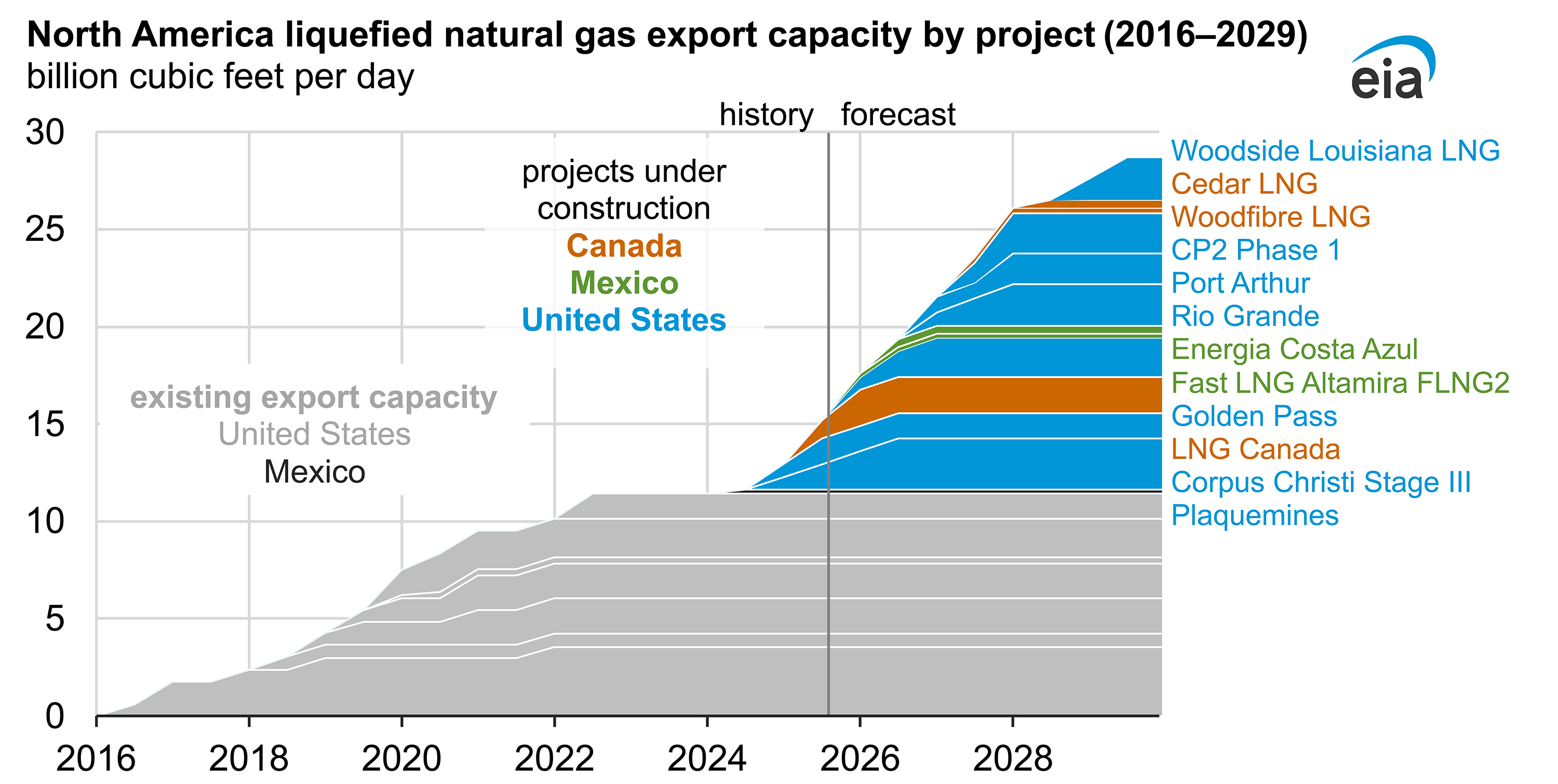
Liquefied natural gas (LNG) exporters in the United States have announced plans to more than double U.S. liquefaction capacity, adding an estimated 13.9 billion cubic feet per day (Bcf/d) between 2025 and 2029, according to our Liquefaction Capacity File and trade press reports.
The United States is already the largest exporter in the world with 15.4 Bcf/d of capacity.
LNG export capacity in North America is on track to increase from 11.4 Bcf/d at the beginning of 2024 to 28.7 Bcf/d in 2029, if projects currently under construction begin operations as planned. Exporters in Canada and Mexico have announced plans to add 2.5 Bcf/d and 0.6 Bcf/d of capacity over the same period, respectively.
North American export capacity additions will total over 50% of expected global additions through 2029, according to the International Energy Agency.
In the United States, the planned liquefaction capacity additions will be concentrated around the U.S. Gulf Coast, already the largest hub for LNG exports in the Atlantic Basin. To supply these terminals, new pipeline projects will be built to transport natural gas from production areas.
However, pipeline construction delays remain a supply risk for new terminals. Plaquemines LNG Phase 1 shipped its first cargo in December 2024. Plaquemines LNG Phase 2 and Corpus Christi Stage III began shipping cargoes earlier in 2025, but they have not yet begun commercial operation.
Five additional LNG export projects in the United States have reached final investment decision (FID) and are currently under construction:
• Port Arthur LNG Phase 1 (1.6 Bcf/d)
• Rio Grande LNG (2.1 Bcf/d)
• Woodside Louisiana LNG (2.2 Bcf/d)
• Golden Pass LNG (2.1 Bcf/d)
• CP2 Phase 1 (2.0 Bcf/d)
